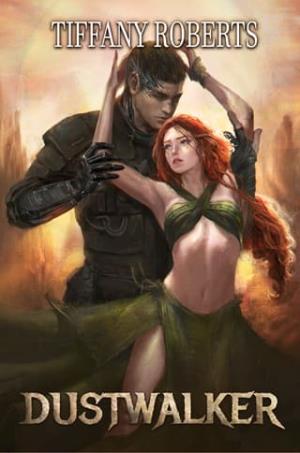
Dustwalker
Chapter 1
CHAPTER ONE
Lara grasped the edges of the large wooden board and heaved.
Pebbles, dirt, and debris tumbled from it as it rose.
She shoved it backward. It kicked up a cloud of dust when it landed, which was swiftly carried away by the wind.
Crouching, she sifted through the exposed bits of splintered wood, rusted metal, and broken ceramics with her fingers.
“Well, what did you think you’d find?” she asked herself as she sat back on her heels and ran her gaze over the crumbled buildings nearby. The ruins of another world surrounded her, blanketed in a thick layer of dirt.
A drop of sweat trickled between her breasts. Though the cloth wrapped around her head and body protected her skin from the sun, it couldn’t keep out the heat. If it weren’t for the stinging sand carried on the frequent gusts of wind, she would’ve torn the sweat-dampened fabric off.
Lara sighed. “What the hell’s left to find in this trash heap?”
Her sister’s voice replied from the depths of her memory.
There’s always something to find, so let’s make it a game. Whoever finds the best treasure gets a larger portion.
Tabitha had always created little competitions to distract from the truth of their circumstances when they were younger, though no matter the outcome, she’d always given Lara the larger share of food.
As an adult, Lara couldn’t ignore reality.
Whether she liked it or not, scavenging was the only way to find things the bots deemed valuable, and even if she didn’t trade with the bots directly, this was the only way she’d get anything to eat.
A pang pierced her chest at the thought of Tabitha.
“Damn bots.” Lara swiped at the debris, knocking aside pebbles and dust.
She hadn’t seen her sister in almost two months.
Two months without seeing her hopeful smile, without hearing her voice, without feeling her comforting touch. Tabitha had disappeared, leaving a gaping void in Lara’s life.
Lara picked through the rubble, tossing every bit of metal she found into her bag. Even if they were small and in rough shape, the pieces were worth something, but she couldn’t help her disappointment. She’d hoped for a more significant find after hours of toiling under the relentless sun.
The soft clink of a rock against a piece of ceramic gave her pause.
She picked up one of the shards and turned it over.
Though faded with time and wear, the blue pattern on it was still visible—part of a flower.
Carefully, she brushed away the loose dirt atop the ground, revealing more shattered pieces with the same floral decorations.
Once, each piece had been part of a larger whole. Bowls, plates, and cups, each beautiful in its own right.
What good are they now? They aren’t worth the dust they’re lying in.
Lara was about to toss the shard back, but the pattern caught her eye again. She’d only ever seen flowers in pictures, and even those were difficult to find. She tucked the shard into a fold of cloth around her waist, away from anything that might’ve damaged it further.
More digging yielded two forks and three spoons, all rusted, which she added to the scrap metal in her bag. Moving aside a rotted wood plank, she found a solid piece of glass. She tugged on it. The resistance told her it was much larger than she’d thought.
Using a flat rock, she carefully dug around the glass, her excitement growing as more of it was revealed. Finally, she pulled it free.
She stared down in amazement at the heavy pitcher in her hands. The glass was foggy and scratched, but it was intact except for a small chip near the base. It had a smooth, curved handle, and was decorated with raised images of flowing leaves and flowers.
Wadding the end of her sleeve in her hand, she rubbed off some of the dirt. The glass caught the sun, sparkling like a rainbow, its hues shifting as she turned it back and forth.
It was beautiful.
Standing, she removed a long piece of cloth from her waist and wrapped it around the pitcher before placing the bundle in her bag.
She picked the bag up and held it to her chest. One little slip, and the pitcher could shatter.
Without a doubt, it was the best thing she’d found in a long time, and Lara was tempted to keep it for herself.
But her empty stomach wouldn’t allow that.
She picked her way through the rubble, heading back to the wide stretch of dirt and scrub grass that served as a road. The pitcher would be worth something to Kate and Gary. Between them and their five-year-old daughter, Maggie, they always needed extra water on hand.
Only their generosity had kept Lara from starvation.
Because they were a family, they were allowed to purchase more food, and usually had a little to spare for Lara when she had items worth trading.
Though she didn’t care for the pity in their eyes when they spoke with her, they’d been kind since Tabitha’s disappearance, and besides… hunger outweighed pride.
She knew Gary received more for her items at the market than he gave her, but he dealt with her fairly. Of course he needed some profit to help support his family. And the loss on Lara’s end was acceptable if it meant she never had to deal with a bot again.
Lara hurried down the road, occasionally glancing at the ruins to either side.
A few of the walls were still upright, teetering in the wind, defying time and nature.
The buildings here hadn’t been built to last; wood and crumbly plaster couldn’t compare to the brick and concrete structures in the market.
At the three-way intersection, she glanced up at the signpost. Tabitha had shown it to her when they were children. Lara couldn’t read the beat-up sign hanging from it, but she recognized the letters. Long ago, she’d asked her sister what those words meant.
The way home, Tabitha had said.
Lara followed the north road back toward the collection of shacks that the humans of Cheyenne dwelled in.
The return trip wasn’t long, but heat and hunger slowed Lara’s pace. The flattened ruins left her exposed to the wind and the biting dust it carried. She kept her head down and adjusted the cloth over her face. She’d be picking grit out of the most uncomfortable places for days.
As she reached the outskirts of town, the dirt, scrub grass, and rubble gave way to small, rickety buildings that creaked in the wind.
Some of the structures had been standing for longer than anyone could remember, repaired using whatever scraps had been available as the years passed.
It wasn’t uncommon for a few of the shacks to fall apart whenever a dust storm blew through, but the inhabitants just gathered the pieces and rebuilt.
The shacks became more numerous as she walked.
With the more densely packed buildings came the stench—refuse and human waste, so potent she considered turning around and heading into the Dust every time it hit her.
She followed one of the northward roads, which was little more than a narrow patch of cracked, hard-packed dirt.
It would become ankle-deep mud within minutes of the first rain.
To the west, the sun plummeted toward the horizon. The people she passed were finishing up their daily business. Best to be indoors before nightfall. The cold was one thing, but no one wanted to be caught outside by a bored, prowling gearhead.
She saw the marks painted on a few of the shacks—a round gear fashioned to look like a skull.
Warlord’s symbol. On bots, it meant they were in his service; on a human’s home, it meant they’d broken the rules.
The first offense didn’t usually result in death, but the places with his mark were often dark and quiet.
Lara dug her fingers into her bag, clutching it tighter. That symbol never failed to make her skin crawl.
When Gary and Kate’s shack came into view, she hurried toward it, cradling her bag like it was the most precious thing in the world. After glancing up and down the street, she knocked on their door.
“Who is it?” The muffled voice belonged to Gary.
“It’s Lara,” she replied, pulling the cloth down from her face.
The door shifted back slightly and slid to the side.
Gary stood in the opening, a tall, thin man whose head nearly touched the top of the doorway.
He wore a pair of tattered jeans and a sweat stained, threadbare shirt.
He couldn’t have been much older than thirty, but years of hardship and scavenging in Cheyenne’s unforgiving weather had aged him and left his skin tanned and leathery.
Despite the harsh lines on his face and his thick beard, he had kind blue eyes.
“Everything all right?” he asked.
“You won’t believe what I found.” Lara opened her bag and pulled out the pitcher.
“Lara, wait—”
“It would be perfect for you and Kate, and little Maggie.”
“Lara, we need to talk—”
“Isn’t it beautiful?” Lara removed the cloth and held the pitcher out to him. “Have you ever seen anything like it?”
She chewed her lower lip anxiously while Gary stared at the pitcher, her arms aching as seconds passed. Surely it was worth more than a thin strip of dried meat or a single vegetable.
Finally, Gary raised his gaze to hers, guilt and pity clear in his furrowed brow. Lara’s stomach sank.
“You could hold a day’s worth of water in this.” She turned the pitcher to display the inside. “Or…or food. You could keep—”
“Lara, we can’t trade anymore.”
Silenced by disbelief, she lowered her arms. He must’ve misspoken, or…
or maybe she’d misheard him? Gary and Kate had helped Lara without hesitation during Tabitha’s absence.
It wasn’t much, but they’d kept her going.
Kept her out of the market. She traded with other people, but no one was as reliable, honest or generous as these two.
“What did you say?” she asked, drawing the pitcher to her chest.