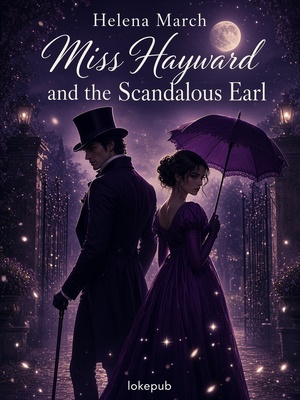
Miss Hayward and the Scandalous Earl
Prologue
“Wit is the most dangerous talent you can possess. It must be guarded with great discretion and good-nature, otherwise it will create you many enemies.”
Dr. John Gregory, A Father’s Legacy to His Daughters
Miss Hayward fluttered her eyelids, her lashes a frantic mimicry of a butterfly’s erratic flight.
“La, sir! You flatter me,” she trilled with a simper.
Lord Richard Balfour, the fourth Earl of Saunton, resisted the urge to roll his eyes at the young lady’s empty-headed flirting as he twirled her across the crowded ballroom.
He had quickly discovered that his dance partner, Miss Hayward, was a proper miss—charming yet vapid.
He could not be happier that this waltz was drawing to a close, as the final strains of music echoed through the gilded expanse of the Astleys’ stately home on the River Thames.
She was a beautiful young woman, her red-blonde hair twisted in a coronet atop her head.
Her complexion was silky and clear; her arched brows framed stormy blue eyes, and her nose was delicate and straight.
Under ordinary circumstances, he might have found her alluring.
However, he knew he must remain on his best behavior with innocent young ladies.
Marriage was a permanent state of affairs, and he needed to be certain he could endure the presence of the woman he chose as his wife.
He could not allow himself to be swayed by mere beauty.
How could he consider matrimony with a woman who, however lovely, could offer little beyond rehearsed pleasantries and inane chatter?
Miss Hayward tilted her head with an expectant smile, clearly waiting for him to continue their conversation.
He resisted the urge to sigh. It was a pity, truly.
With her charm and grace, she might have been a promising partner—had she possessed the lively wit and spirit he had once found in another.
His expectations for marriage were not lofty, but Miss Hayward was simply too frivolous to consider as a life partner.
Yet, he could not deny he enjoyed the sensation of her slender waist beneath his hand; her rosewater scent stirred an unwelcome nostalgia for the intimacy he had relinquished when he ended his last arrangement.
The decision had seemed prudent—an effort to project sincerity in his courtship attempts, ensuring fathers would welcome his suit.
However, Miss Hayward’s slim form beneath his palm distracted his thoughts in a decidedly inappropriate direction.
The 1820 Season had officially begun, and Richard already felt the creeping weight of boredom as he contemplated the months ahead.
If only his former betrothed, Miss Annabel Ridley, had not seen fit to hare off across the country and marry his cousin, the Duke of Halmesbury, in a fit of pique.
He would already be wed and expecting an heir.
Instead, he was condemned to endure this endless parade of polite society, seeking a tolerable bride.
Annabel. The name echoed unbidden in his mind, though he wished it would not.
She had been the spark amidst the dull embers of the ton—a woman who had amused him and, at times, challenged him, but never bored him.
Her decision to marry his cousin had left him in this unenviable position: wading through a sea of dutiful smiles and stifling propriety.
Endless small talk, nauseating orgeat, and watered-down lemonade punctuated the monotony of a parade of young ladies, all ruthlessly molded by their mothers into paragons of demure perfection.
Yet, not one had a hint of originality or wit to recommend her.
That absence was why he had chosen Annabel in the first place.
Was it too much to ask to marry a woman with whom he could hold an intelligent conversation?
Tonight, the prospects appeared grim. It was a pity Miss Hayward was such an irredeemable flibbertigibbet; otherwise, he might have been tempted to steer her toward the terrace to steal a kiss and briefly escape his ennui.
Miss Sophia Hayward was a keen observer of people, especially men.
She had to be, to have avoided marriage for the past three Seasons—four, if she successfully traversed this one without receiving a marriage proposal.
Observation was key to her plans, as her sizable dowry undermined her efforts to remain unmarried.
How large her dowry was, she did not know; her uncle, who served as her guardian, was notoriously tight-lipped and protective of his family, much like her grandfather before him.
Her keen observational skills accounted for why, when the Earl of Saunton—the very wealthy but notorious rogue now searching for a wife—requested this waltz, Sophia had intuitively leaned into her silly debutante act, a persona she had honed over the past three years.
Her ingénue act involved fluttering her eyelashes, using insipid language, and engaging in dull small talk about needlework, the need for various shades of ribbon, and the fine selection of gloves at the shop she had visited that day.
For another type of gentleman—the sort seeking a docile and proper wife, drawn to such behavior—she employed her bluestocking act.
This strategy consisted of sounding disgracefully intellectual, with detailed analyses of Shakespearean works, discussions about the many hues of roses yet to be cultivated, and the selection of classical literature available at the bookshop she had visited.
The two strategies were surprisingly similar, albeit on opposite ends of the academic spectrum. The art lay in knowing which strategy to employ and being sufficiently subtle to avoid her aunt and uncle hearing reports of untoward behavior from the gentlemen in question.
To his credit, Saunton was the former type of gentleman.
Just when she began listing all the ribbons she had collected over the years, he desperately redirected her chatter to a discussion about horseflesh.
It amused Sophia to note how his eyes glazed over and his charming smile fixed itself in place, as though painted on by an artist’s brush.
Clearly, he had already lost interest in her as a prospective bride, which suited her perfectly.
Sophia could not deny that the gentleman was devilishly handsome.
His dark brown curls, long lashes framing distinctive green eyes, and athletic build—all without a hint of padding beneath his tailored clothing—made him the most attractive man at the Astleys’ ball.
His pearly white teeth and perfectly sculpted lips caused her to wonder, briefly, what it might be like to kiss him.
Nevertheless, she steeled herself against the pleasing warmth emanating through their gloves as he clasped her hand to lead her in what was, admittedly, a graceful waltz.
He was the very worst of husband prospects—"devilish" being an apt description. Besides, she had no intention of marrying at all, despite her nagging aunt and persistent uncle, who believed it their duty to see her safely married. She was no fool. She had seen what marriage had done to her mother, and there was nothing “safe” about her mother’s untimely demise.
Sophia planned to bide her time until she could claim her dowry and live independently.
She exhaled a quiet sigh of relief as the dance ended, while Lord Saunton dropped a curt bow, visibly relieved.
Plastering a polite smile on her face, she kept her expression vapid as he escorted her back to her aunt and cousin at the edge of the ballroom. He offered her aunt a shallow bow before taking his leave.
Her strategy to dissuade his interest seemed to have worked, though she could not deny that an ill-advised visit to the terrace to discover whether his sculpted lips were as kissable as they appeared would make for a pleasant interlude.
It was unusual for her to entertain such thoughts, but Saunton was an unusually handsome man with an amiable smile and playful manner that were … very appealing.
She could also appreciate that he never gambled, drank only in moderation, and managed his estates with financial acumen—attractive qualities, given the circumstances of her papa’s death.
Still, he was a rogue not to be trusted, and Sophia had no intention of seeking a husband.
Playing bland had been easy in his company, because he was so easy to read.
All she had to do was bat her eyelashes and flirt vacuously while pretending to listen as he spoke about the weather and riding.
He certainly seemed to make good use of his stables, if his conversation was any indication.
She had stopped herself from displaying any useful knowledge about horses; she had no wish to encourage his attentions.
Sophia sighed, contemplating with weariness that the evening had only just begun, and hours of polite conversation and dreadful orgeat awaited her.
From their position at the edge of the ballroom, she and her cousin watched the lengthy quadrille while fluttering their fans.
The room grew warmer as the mingled scents of pomades and perfumes filled the air.
Even the music sounded shrill, though perhaps that was her mood.
She wished she could be home with a book or enjoying a stimulating conversation with her cousin Lily in the library.
Turning to Lily, her closest friend and confidante, Sophia deliberately glanced toward the terrace. Her tiny cousin, with her enormous brown eyes and delicate, elfin face, immediately understood. Lily turned to her mother, Sophia’s aunt, and prepared their escape.
“Mama, I believe my hem is coming loose. Sophia and I will find an alcove to mend it and return shortly.”
Lady Moreland waved a gloved hand in assent as she continued to gossip with the turbaned Lady Astley, a haughty and unpleasant woman Sophia had no wish to know.