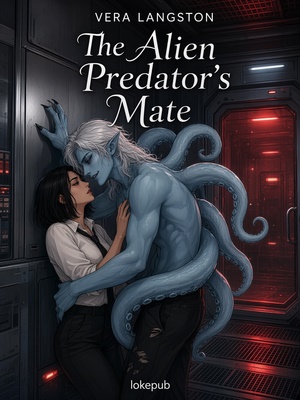
The Alien Predator's Mate
Chapter 1
Chapter
One
Ash Valley is one step away from hell on Earth.
It’s a shame, really. Deserts are always fascinating to read about.
They’re a perfect example of life’s ability to adapt to any circumstances.
Cacti store enough water to survive the long, dry months without rain, and in turn, they provide food and shelter for wildlife.
A unique ecosystem, existing and thriving in a place that seems uninhabitable.
There is a graceful, satisfying order to it all.
But reading about it did not prepare me for the sheer overwhelming reality of the temperatures in Arizona.
Oh, God, the heat. I arrived in town late last night, admiring the silhouettes of saguaro against the starry sky, and found it dry and warm but bearable.
This morning, however, I burned myself on my seat belt buckle when I got into the car, and then again when I touched the steering wheel.
Five minutes into the drive and I’m sweating through my blouse despite the air-conditioning’s best attempts at keeping the summer at bay.
I drive through quiet neighborhoods and empty, lifeless streets surrounded by stretches of desert, my tension mounting.
It is all very quaint, with tiny adobe houses and hand-painted signs.
The farther I drive, the more I wonder where, precisely, I can find the facility that offered me a job as a research assistant.
I was surprised when the offer came in. There weren’t a lot of opportunities for me, fresh out of college with an ecology degree and very little hands-on experience.
I certainly wasn’t expecting for a chance to come from a tiny town in Arizona and a research facility that, according to the Internet, barely exists.
If it exists at all. I’m starting to have my doubts.
My hands tighten on the still-hot wheel as I drive, eyes scanning the mountains on the horizon.
Finally, I pass through downtown, and…there.
It’s unmistakable once I lay eyes on it.
A boxy metal building on the outskirts of Ash Valley, startlingly incongruous in this little town.
It’s sterile and imposing, entirely windowless, surrounded by fences topped with barbed wire and manned guard towers.
The Melsbach Research Facility.
They must have better funding than I anticipated, with security like that.
Better funding means better equipment and more-important work.
Although now I’m wondering more about the nature of their research.
I thought the NDA they sent me was a formality.
I assumed their refusal to share details until I receive security clearance was normal.
But now I wonder, could they be hiding something here, deep in the desert?
Is this a government job of some kind? Surely they would have mentioned that…
As I pull up to the front gate, I smooth down my outfit and push aside those thoughts.
I lower my chin and force my shoulders down, letting myself shrink.
I have been told so many times throughout my education that I am too imposing, too talkative, too much.
Arrogant, bossy, mean. If I were a man, those traits would put me on a path to leadership.
Because I’m a woman, it makes me difficult to work with.
One would think that things would be different here in the early 2000s, yet here I am.
So at this place, my first post-college job, I intend to be subservient and quiet for the sake of my career.
Like the saguaro cacti, I’ll find a way to survive in unlikely circumstances.
Even if the work here is dull, it will still lend me valuable field experience and allow me to move on to bigger and better things.
My dream has always been simple: a lab of my own, and work that can actually make a difference in this weird and wonderful world.
But they don’t hand that kind of power—or money—to a fresh college grad, and I’m getting ahead of myself.
First things first: I will be the best damn research assistant this place has ever seen.
After a guard checks my ID at the gate, I enter the main building, where I’m met with a blast of air-conditioning and another, more robust security checkpoint. I’m scanned and patted down; scowling security officers search through my purse and confiscate my cell phone.
Feeling a bit rattled at this point, I step into a lobby that is clean and sparsely decorated. White floors, white tile, and not a singular hint about the nature of this place. A lone man stands, waiting for me.
“You must be Ms. Wright,” he says, extending a hand. “Dr. Allen Ramsey. Welcome to the MRF.”
He’s perhaps ten or twenty years older than me, in his thirties or forties. Handsome, with a pair of striking blue eyes behind his glasses, and thick, dark hair.
“Pleasure to meet you,” I say, releasing his hand.
There’s something knowing in his smile, like he can instantly clock my attraction to him, even as I try to keep my expression neutral.
“We’ll be working together under Dr. Akimov. Let me show you to the lab.”
I straighten up, put on my practiced smile: polite but lacking warmth. “Of course. Lead the way.”
Ramsey leads me through a seemingly endless maze of identical hallways lined with identical doors.
It’s empty and eerily silent except for the faint buzz of fluorescent lights overhead and the click of my heels against the white tile.
My feet hurt from wearing these damn things, and it’s hard to keep up with Ramsey’s long strides.
Finally, Ramsey stops in front of one of the many doors, this one labeled Observation Room 11. He gives a cursory check over his shoulder to make sure I’m still keeping up, and then opens it and steps inside, holding the door for me to join him. A bark of laughter cuts off sharply.
Two other scientists wait within. Both male.
It doesn’t surprise me, but as the door clicks shut behind us and I find myself standing alone in the room with three male strangers, I can’t fight a jolt of nerves.
I’m all too aware of my heels, my skirt, my makeup—things that I’d be called attention-seeking for wearing, yet unprofessional if I didn’t.
The room is silent after that hastily aborted laugh. It seems to hang in the air, the sound more foreboding in retrospect. The air is thick with the tension of a conversation that ended the moment I walked in.
I swallow hard and survey the laboratory instead of focusing on the men staring at me.
The space is cramped, and crammed with equipment.
A multitude of CRT monitors, a microscope, a medical refrigerator full of test tubes, and other machinery fill the space.
More high-tech than I’d expect from a building out in the middle of nowhere, though the building’s exterior already gave me an inkling that the location might be deceptive.
“This is our new lab assistant, Ms. Calliope Wright,” Dr. Ramsey says, breaking the discomfiting silence.
One of the men—thin and gray-haired, with pale eyes exaggerated by round metal glasses—gives me a firm nod. “Dr. Akimov. Lead scientist.”
“Nice to meet you,” I say.
The other man introduces himself, in a half-hearted murmur, as Dr. Tabs, his eyes lingering on my chest before darting guiltily away. I carefully tuck away their surnames in my memory as I fold my hands behind my back and study the room again.
The square shape of a window is set in one wall; the building was windowless from the outside, so it must be looking into the room next door. The glass is covered by metal shutters. I eye it, curious, but bite my tongue instead of asking. I’m trying to avoid attention, I remind myself.
“Do you have any interest in space, Ms. Wright?” Akimov asks, and I turn back to him, blinking. The other scientists are regarding me silently.
“My background is in ecology,” I say after a belated moment, dumbfounded by the question.
His lips curl into a smile that’s just teetering on the verge of mockery.
“I’m aware. I’m asking about personal interest. Are you interested in our galaxy?
In the stars?” When I don’t answer right away, he prompts, “If it’s life that you study, perhaps life beyond our planet might be of interest to you? ”
Dr. Tabs titters under his breath, and Akimov shoots him a sharp look.
I hesitate, feeling off-balance. Trying to figure out what kind of response he’s looking for, and all too aware of the eyes of all three men on me.
Their gazes make my skin itch, and I fight the urge to pull down my skirt, though it’s nearly to my ankles already.
The question feels like a trap, especially after Tabs’s laugh, but I’m not sure how to avoid being caught in it.
“I think there’s enough life on Earth to keep me busy for a lifetime,” I say carefully. Surely men like him value practicality above all.
Tabs snorts again, as if I’ve said something amusing. Ramsey is watching me with an unreadable expression, and Akimov’s gaze narrows on me.
Akimov steps over and places a hand on my shoulder. His touch makes my skin crawl, and it takes all of my effort not to cringe away. Somehow, I manage to keep smiling even when I think about punching him in his leathery throat.
“The question, my dear”—oh, how I hate those pet names—“is whether or not you believe in extraterrestrial life.”
My eyebrows twitch together, but I keep my smile as bland as possible. I don’t know what the hell this is supposed to be—a trick, a test, a joke?—but I know it’s best to be a gray rock to this type of men, as uninteresting as possible.
“I have seen no evidence for or against it. So as a scientist, I must—”
“But what do you believe?” he asks, interrupting me.
“I believe it’s highly unlikely we’re the only life in the universe,” I say. “So even though I haven’t—”
“Very good,” he says in a powerfully condescending tone, as if he’s taught me some kind of lesson. “This will be easier, then.” He moves over to the shuttered window.
I bite the inside of my cheek and steal a glance at Ramsey as I move to follow. Ramsey’s lips hold the slightest hint of a smirk, and he lifts his broad shoulders in commiseration as I meet his gaze. It eases my annoyance.
“Oh, let’s just get on with it,” Tabs says with a forced yawn. “We’re wasting the morning. Show her the subject.”
The subject? My brows rise, and I steal another glance at Ramsey. He’s staring at the metal shutters now. At a nod from Akimov, he pulls a lever, and they open with a faint groan.
As I thought, the shutters slide open to reveal a window into the room beside this one.
In contrast to this crowded space, the room next door is sparse.
The walls and tile are white, just like the rest of the building.
The only furniture is a strange metal bed with an oval-shaped glass cover. Beside it stands a man.
He appears to be in his mid-twenties, clean-shaven and almost boyish, with sharp, intense features. His brown hair is combed neatly, and he wears a white lab coat over a shirt and slacks. His feet, oddly, are bare on the tile.
Tabs gives an over-the-top shudder and a low noise, as if disgusted or disturbed.
I glance at him, brow furrowed, and then at the other scientists.
None of them are being theatrical like he is, but there’s a thread of tension in the air.
All eyes are on the man in the other room.
I realize, belatedly, that the outfit he’s wearing is almost identical to theirs, lab coat included.
“This is Subject X-11,” Akimov says in his crisp, cold voice. “He is the first discovered extraterrestrial life-form.”
A beat passes. Another. I glance at Akimov, at the others. It feels like this must be a prank, but nobody is laughing.
“I don’t understand,” I say. “He’s just a man.”
“Look again,” says Akimov.
I frown, push up my glasses, and peer more intently through the window. The man’s posture is stiff, though his hands hang loosely by his sides. His expression is perfectly blank in a way that’s almost unsettling, especially since it’s at odds with the sharp alertness in his eyes.
“Can he see us?” I ask, my voice dropping to a whisper for reasons I can’t explain. Surely this is just another test of some kind. But…
“Not him,” Akimov says. “It. It cannot see us, as it’s a one-way mirror, but it can likely hear us. Or sense the vibrations, at least. We’re unclear on how exactly it perceives the world, but its senses are very strong.”
There isn’t anything strikingly inhuman about him. But…something isn’t right. He’s too still, too stiff, his posture ramrod-straight, like a mannequin rather than a man. When he tilts his head, the movement is twitchy, birdlike.
Or am I getting paranoid and seeing things? I waver. Yet even as I tell myself I’m being ridiculous, the hairs on the back of my neck prickle at full attention, as if in warning of some unseen danger.
“It isn’t a man,” Ramsey says. “But it is getting better at pretending to be one.”
“It looks just like him,” Tabs says, and an uncomfortable silence falls.
“Like who?” I ask after a beat.
“Like Mulford,” Ramsey says. “Our last lab assistant.”
I tear my eyes off the subject—the alien, if what they’re telling me is true—and look at him. His expression is grim, a troubled furrow on his brow as he studies the man—creature?—on the other side of the glass.
“And what happened to Mulford?” I ask, though I’m afraid of the answer.
Ramsey nods at the subject. “That thing happened.”