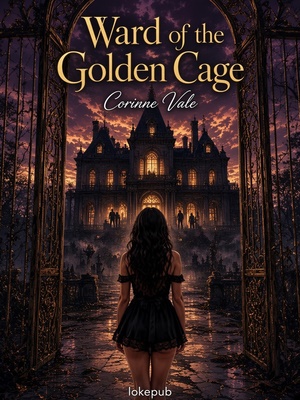
Ward of the Golden Cage
1. The Weight of a Name
The Weight of a Name
Monika
The mirror doesn't lie.
That's the thing about glass—it shows you exactly what you are, what you've become, what's been taken from you and what you've given away. No flattery. No mercy. Just reflection.
I've been standing here for twenty minutes, maybe longer.
The morning light is grey through the east-facing windows, that particular shade of dawn that exists only in winter, when the sky can't decide whether to commit to day or surrender to night.
The heat from the fireplace has long since faded, leaving the room cold enough that my breath fogs the glass if I lean too close.
I lean closer anyway.
The woman looking back at me has my face. Same dark hair, though it's longer now, past my shoulders in a way my mother never let me wear it. Same brown eyes, though the light in them has dimmed. Same mouth, though it's learned to press into a thin line when I don't want to scream.
But she's not the same girl who walked through these doors a year ago. That girl had calluses on her hands from work that mattered. That girl had dreams that didn't taste like ash. That girl had never been touched by three men who loved and consumed in equal measure.
I trace the bruise on my hip. It's purple and yellow at the edges, the kind of mark that takes days to fade completely. Nathan's. From last night. From the way he'd pushed me against the wall in the hallway outside my room, his hand over my mouth, his body hard and demanding against mine.
"You're mine," he'd said. Not a question. Not a declaration. A fact. The same way gravity is a fact. The same way the sun rises.
I'd let him take what he wanted. I always do.
With Nathan, it's easier that way. Fighting him only makes him more possessive, more hungry, more determined to prove that I belong to him.
So I'd pressed my palms flat against the wallpaper—that hideous floral pattern that's probably been there since the seventies—and I'd let him fuck me until I couldn't remember my own name.
He'd left without saying goodbye. He always does.
The house is waking up around me. I can hear the servants moving in the kitchen below, the soft clatter of dishes, the distant murmur of voices. Viktor's voice, low and gravelly, giving instructions. Ashlynn's, sharp and efficient, cutting through the morning silence.
One year.
Three hundred and sixty-five days since a bleeding man walked into my diner and changed everything.
I press my hand to the mirror. My reflection presses back.
The dining room is too large for four people.
It's always too large. The table could seat twenty comfortably, thirty if you didn't mind elbowing your neighbor.
The chandelier above it is made of crystal that probably cost more than the farm I grew up on.
The paintings on the walls are originals, oils, the kind of thing that belongs in museums, not in a private home where three men use them as backdrop for their constant, simmering war.
I've been sitting at this table for a year. I still feel like an intruder.
Aleksander is at the head, as always. He's wearing a charcoal suit, crisp and expensive, the kind of thing that makes him look like he owns the world—which, in a way, he does.
His hair is silver at the temples now, more than it was a year ago.
The lines around his eyes are deeper. He's been sleeping less, worrying more.
I can see it in the way his jaw tightens when he looks at his sons.
He looks at me when I enter. His grey eyes find mine immediately, and something in his face softens—just slightly, just enough. The same way it did that first night in the diner, when I pulled a bullet from his side and he looked at me like I was something precious.
Like I was something worth saving.
"Monika." His voice is low, rough, the kind of voice that's used to being listened to. "You're up early."
"Couldn't sleep."
It's not a lie. I haven't slept through the night in months. The dreams come too often—the barn, my mother, the cages in the warehouse. Sometimes I wake up screaming. Sometimes I wake up silent, tears already on my face.
Nathan slides into his seat across from me.
He's late—purposefully, I suspect, because punctuality is for people who care what others think.
His dark hair is disheveled, his shirt untucked, the top button undone to reveal the hollow of his throat.
He looks like he's been up all night, or like he just rolled out of someone else's bed.
He hasn't been in someone else's bed. I know because I was in mine, and he was in his office, making calls he didn't want me to hear.
"Morning, farm girl." His smile is sharp, predatory. The same smile he's been wearing since the day we met. "Sleep well?"
I don't answer. I don't have to. He knows I didn't.
Gabriel is the last to arrive. He's been spending more time in the greenhouse, more time in the library, more time anywhere that isn't here. He's wearing a sweater that looks too big for him, his hair disheveled, his eyes red-rimmed. He looks like he's been crying.
He takes his seat without looking at anyone. His hands are shaking slightly as he reaches for his coffee.
The silence stretches.
This is how breakfast always starts now. A year ago, the table was loud—Gabriel asking questions, Nathan making jokes, Aleksander observing with that quiet, knowing smile. A year ago, I thought this family was strange but salvageable. A year ago, I was naive.
Now we eat in silence. The clink of silverware. The soft sound of coffee being poured. The weight of all the things we're not saying pressing down on us like a physical force.
"We should celebrate."
Aleksander's voice cuts through the silence. I look up. He's watching me, his grey eyes steady, his hands folded on the table in front of him.
"Celebrate what?" Nathan asks. His tone is flat, dismissive.
"The anniversary." Aleksander doesn't look at him. He's still looking at me. "It's been a year since Monika came to us. That's worth marking."
I feel something cold settle in my chest. The anniversary. A year since I signed the papers. A year since I gave up my name and took theirs. A year since I became property in everything but law.
"I don't think that's necessary," I say. "It's just a date."
"Every date is just a date." Aleksander's voice is soft, almost gentle. "But some are worth remembering."
Nathan snorts. "A party. To celebrate a year of keeping the farm girl in a gilded cage. How festive."
"I wasn't suggesting a party." Aleksander's eyes finally move to his son. "I was suggesting a small gathering. A dinner. Just family."
"Just family." Nathan's smile is all teeth. "Because that's been working so well."
Gabriel pushes back his chair. The legs scrape against the marble floor, a harsh sound that echoes through the room. "If you'll excuse me."
"Gabriel." Aleksander's voice is sharp. "Sit down."
"I have work to do."
"It can wait."
Gabriel pauses. He looks at his father, his face pale, his eyes red. "No," he says. "It can't."
He leaves. The door closes behind him with a soft click, and the silence that follows is heavier than before.
Nathan laughs. It's a brittle sound, hollow and sharp. "And there it is. The great Gabriel Mire, retreating to his greenhouse to cry over the orchids. That's going to fix everything."
"Enough." Aleksander's voice is barely above a whisper, but it cuts through the room like a blade. "You will not speak about your brother that way."
"Or what?" Nathan leans forward, his elbows on the table, his eyes locked on his father. "What are you going to do, Aleksander? Ground me? Take away my allowance?"
"Nathan."
"I'm twenty-three years old. I've been running your business for the past year while you've been distracted by—" His eyes flick to me, sharp and knowing. "—other things. So don't sit there and pretend you have any authority over me."
The air between them is thick, charged. I can feel it pressing against my skin, raising the hair on my arms. This is how it always starts. The silences. The small jabs. The escalating tension that never quite boils over.
It's going to boil over soon. I can feel it.
I can feel the cracks widening.
"That was a lovely breakfast."
Nathan's voice is soft in my ear. His hand is on my lower back, guiding me down the hallway toward the library. I don't want to go to the library. I want to go to the greenhouse. I want to find Gabriel and hold him and pretend this family isn't falling apart around us.
But Nathan doesn't give me a choice. He never does.
"It was a disaster," I say.
"That's what made it lovely." He pushes open the library door. The room is dark, the fire unlit, the bookshelves looming in the shadows. "We've stopped pretending. It's refreshing."
"You call that refreshing?"
"I call it honest." He pulls me inside, closes the door behind us. His hands find my hips, his thumbs pressing into the soft flesh where the bruise from last night is still fading. "We're all too tired to lie anymore."
I should push him away. I should walk out of this room and find Gabriel and let him hold me the way he needs to be held. I should do something other than stand here, frozen, letting Nathan Mire touch me like he owns me.
"I need to go," I say.
"Go where?"
"The greenhouse. Gabriel was upset—"
"Gabriel is always upset." Nathan's voice is flat. "It's his defining characteristic. That and his desperate need to save you from a situation you don't want to be saved from."
"He's trying to help."
"He's trying to make himself feel better by pretending he's the good one. It's not the same thing." Nathan's hand slides up my back, his fingers splaying across my shoulder blades. "Stop protecting him."
"I'm not protecting him."
"You are. You always do. You see the broken little bird and you want to put him back together. But that's not your job. You're not his savior."
"Then what am I?"
He pauses. His eyes find mine in the dim light. There's something in them I don't recognize—something almost like vulnerability.
"You're mine," he says.